

How fast you’re really aging — and how to take the wheel.
You have two ages. One you celebrate every birthday. The other — quietly, every single day — is writing the story of how you’ll actually feel, perform, and function for the decades ahead. Most people never measure it. The ones who do gain something rare in medicine: the chance to change the ending.
The Two Ages You’re Living
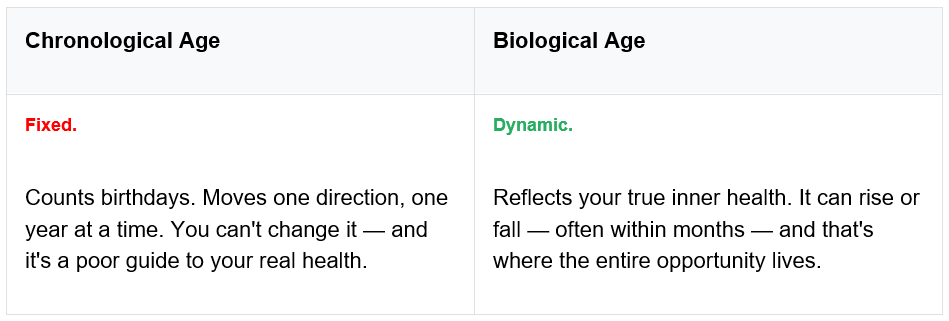
Your chronological age is the number of times you’ve circled the sun. It’s honest, it’s fixed, and it tells you almost nothing about your health. Your biological age is different — it reflects how well your cells, organs, and systems are actually performing right now, today.
Two people can both be 50 on paper. One carries the biology of a vibrant 42-year-old; the other, the worn-down systems of a 60-year-old heading for trouble. Same birthday, completely different futures. Biological age is the number that quietly predicts how you feel, how you perform, and how long you stay in the game — and unlike the calendar, it’s a number you can move.
It’s Not Just Where You Are — It’s Where You’re Headed
Two numbers, like a dashboard, tell you almost everything.
Imagine your aging as a car. The first number is the odometer — the total wear and tear your body has accumulated so far. The second, and arguably more important, is the speedometer — your pace of aging, the biological years you add for every calendar year that passes.
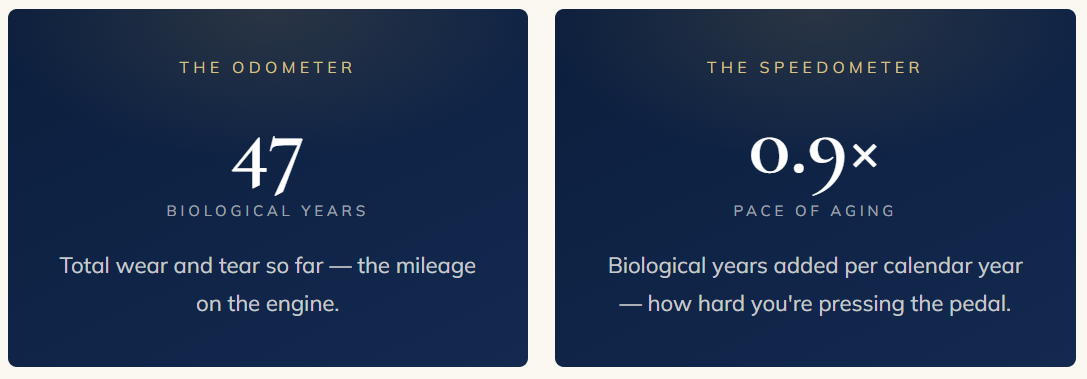
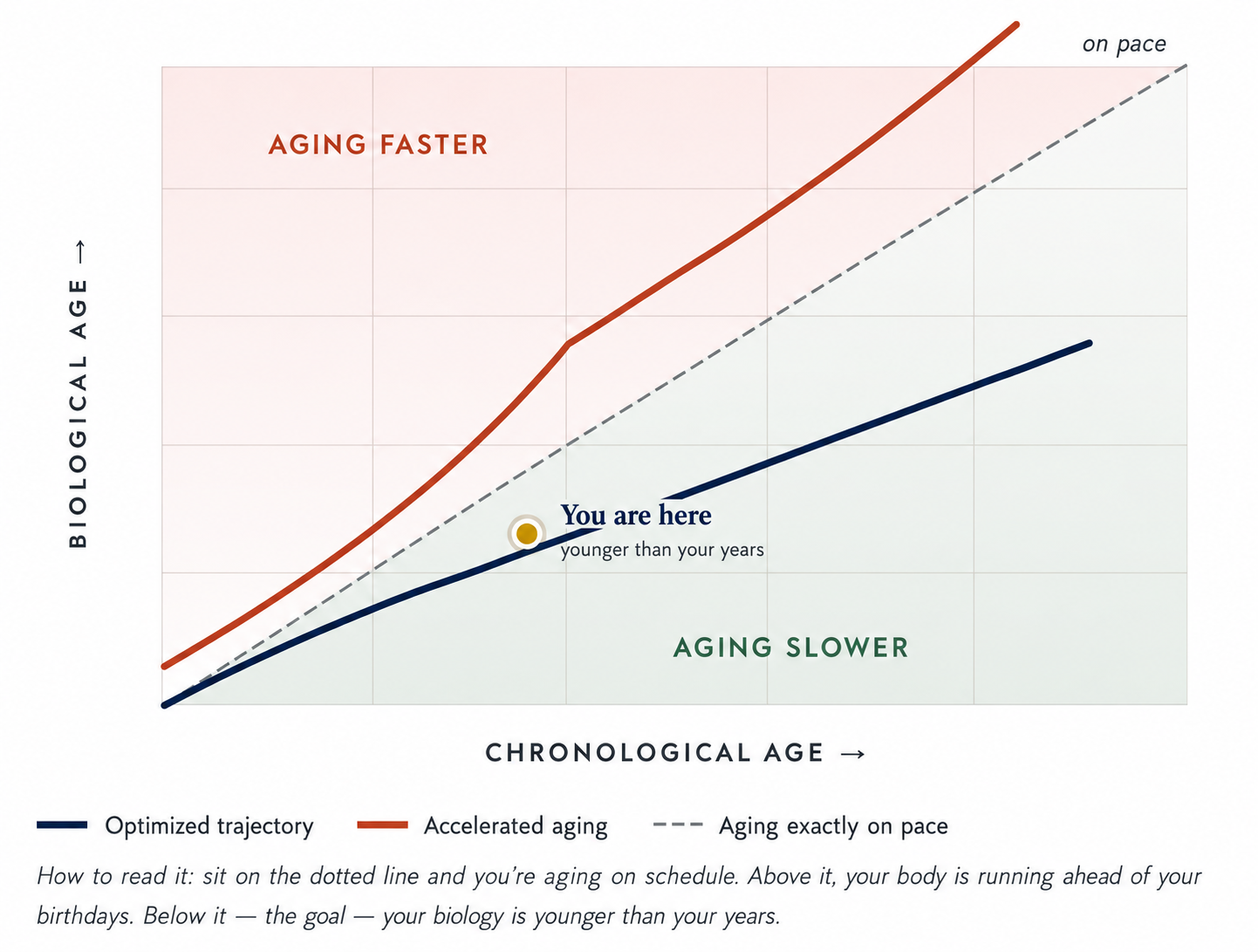
You might be aging at 1.3× — gaining nearly a year and a half of biology for every birthday — or at 0.8×, quietly slowing the clock. That single multiplier, compounded over a decade, is the difference between arriving at 60 feeling 70… or feeling 50. Pace is so important because it’s a leading indicator: it reveals the direction you’re trending before the damage shows up as a diagnosis.
Your trajectory is simply where today’s choices are taking you over the next ten years. The good news is that the line bends. Everything we do together is designed to ease off the accelerator and curve that line in your favor — gently, measurably, and starting now.
Where Aging Shows Up: The Four Horsemen
Nearly everything that shortens a modern life arrives from four directions.
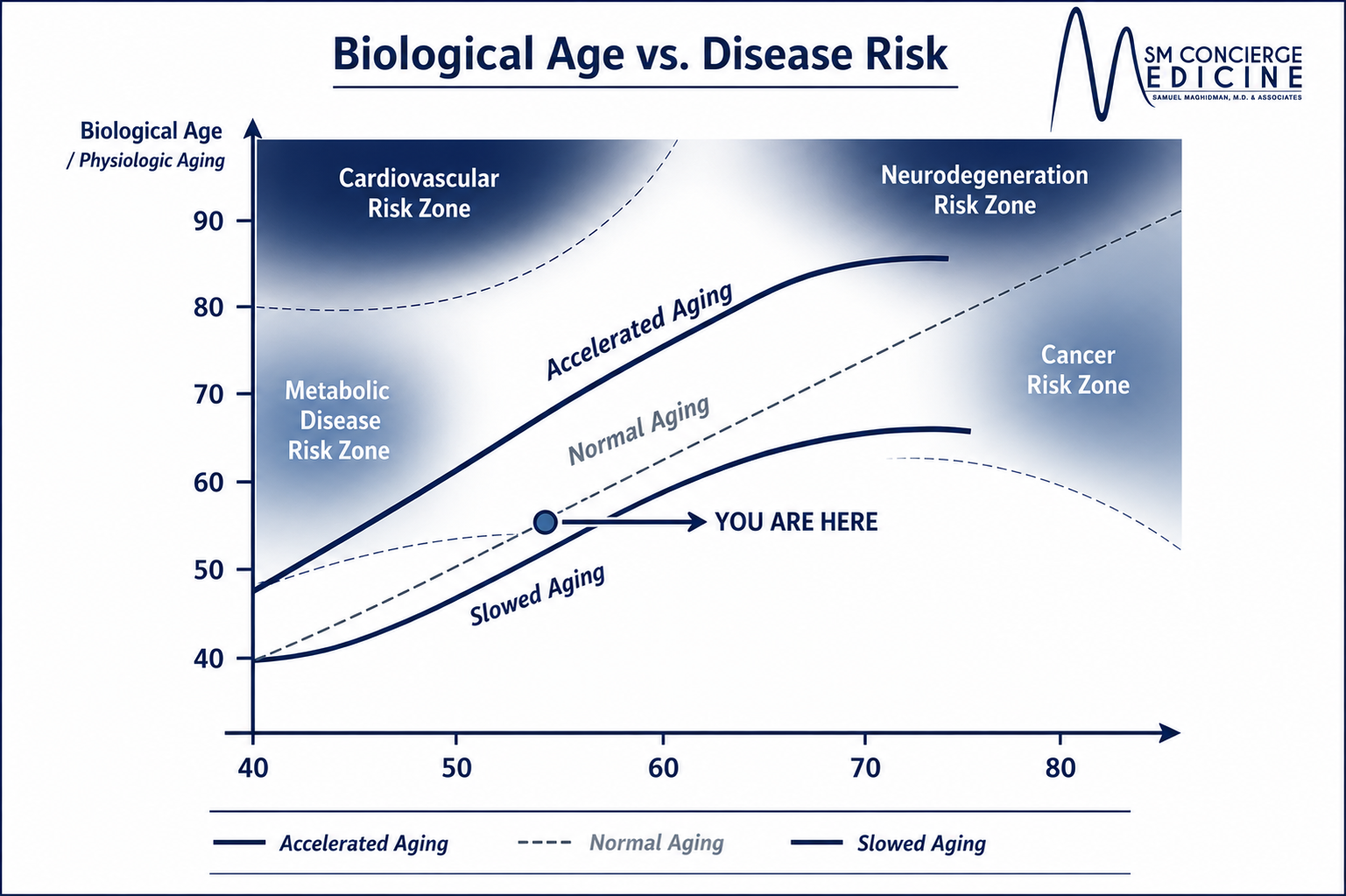
In longevity medicine we call them the Four Horsemen. They are not random misfortunes — they are the chronic diseases that account for the overwhelming majority of deaths after age 50. Aging quietly raises your odds in all four lanes at once, often for years before a single symptom appears. That silent window is exactly where the opportunity lives, because it’s where prevention still works.
Cardiovascular
Your heart and blood vessels — still the leading cause of death worldwide, yet among the most preventable when we look decades ahead at markers like ApoB, Lp(a), and arterial inflammation rather than waiting for a symptom.
Cancer
Cellular damage that slips past the body’s quality control. Early detection and a resilient inner environment — metabolic, immune, and inflammatory — shift the odds dramatically in your favor.
Neurocognitive
Your brain, memory, and clarity. Protecting cognition is a long game that begins in your 40s, not your 70s — the changes that lead to decline start decades before any forgetfulness is noticed.
Metabolic
Blood sugar, insulin, and how you convert food into energy — the hidden engine behind the other three, and the single most responsive to change once we measure it precisely.
The Common Thread
Running underneath all four is your immune & inflammatory balance — the quiet background hum of aging that researchers call “inflammaging.” It fuels autoimmune and degenerative disease and accelerates every other Horseman. Calm that hum down, and every single lane gets safer.
How We Actually Measure It: Five Biological Clocks
Science can read your aging from several different layers of biology.
Putting an honest number on aging is one of the most active frontiers in medicine. Researchers have built several distinct biological clocks, each reading a different layer of you. Understanding them is what separates a meaningful measurement from a gimmick.
1. Epigenetic Clocks
Read the chemical “switches” (DNA methylation) that sit on top of your DNA and control which genes are active. The most validated and widely used family today— including second-generation clocks that estimate disease risk and pace of aging, not just age.
Our clock of choice
2. Telomere Length
Measures the protective caps on the ends of your chromosomes, which naturally shorten with cellular wear. Intuitive and historically important, but noisier as a standalone readout.
3. Transcriptomic Clocks
Look at which of your genes are actively switched on right now — a real-time snapshot of your biology in motion.
4. Proteomic Clocks
Measure thousands of proteins circulating in your blood to gauge how individual organs — heart, kidney, brain, liver — are holding up, sometimes years apart from one another.
5. Metabolomic & Inflammatory Clocks
Track the small molecules and inflammatory signals that reflect your day-to-day metabolic wear — the most responsive to lifestyle change.
Here’s What Most People Get Wrong
These clocks don’t always agree with one another, and jumping between them creates noise instead of insight. A result that swings five years between two different tests tells you nothing about your health — only about the difference between the tests. So we choose one validated clock and follow it consistently, the same way, at every check-in.
Trends beat snapshots. A single clock, measured the same way over time, is what truly tells us whether your plan is working.
The Best Part: Your Biological Age Is Not Fixed
This is where it gets genuinely exciting. Unlike the calendar, your biological age responds — often within months — to the right inputs. We’ve watched trajectories bend. Three levers move the needle the most.
Hormonal Balance
Optimized hormones are the body’s master signals for repair, energy, sleep, and resilience. When they drift with age, recovery slows everywhere; restoring them — judiciously and with monitoring — is one of the most powerful levers we have.
Targeted Supplements
The right molecules, at the right doses, chosen for your biomarkers — not a generic shelf of pills. We supplement to correct what your labs actually show, then re-measure.
Lifestyle
Sleep, movement, nutrition, and stress — the daily inputs that quietly set your pace. Unglamorous, free, and more powerful than almost anything in a bottle when done with precision.
Because this metric is so dynamic, we treat it like a living dashboard: measure, adjust, re-measure, and watch the curve bend in your favor — season after season. It is the closest thing modern medicine has to a feedback loop on aging itself.
What This Looks Like With Us
At SM Concierge Medicine, biological age isn’t a one-time novelty test — it’s a thread that runs through your entire longevity plan. We begin by establishing your baseline: your biological age, your pace of aging, and a precise look across all four Horsemen using advanced cardiovascular, metabolic, hormonal, and immune markers. From there we build a personalized protocol, then re-measure on a defined cadence so you can see whether the curve is bending the right way. That is what Medicine 3.0 means in practice: proactive, data-driven, and built entirely around you.
Frequenlty asked questions
Is biological age a “real” medical number or just a wellness fad?
It sits in between, and we’re honest about that. Biological-age science is a legitimate and fast-advancing field — the underlying clocks are published, peer-reviewed research tools. But it remains an evolving area, the science is still maturing toward routine clinical use, and individual results vary. We use it as one powerful lens within a broader, rigorous clinical picture — never as a stand-alone verdict.
How quickly can my biological age actually change?
Some markers — particularly metabolic and inflammatory ones — can respond within weeks to months of focused change. Deeper epigenetic shifts unfold more gradually. This is exactly why we track trends over time rather than reacting to any single result.
Why measure the same clock every time instead of trying several?
Because different clocks measure different things and rarely agree on an exact number. Switching between them introduces noise that can look like a real change when it isn’t. One validated clock, measured consistently, gives a clean signal of whether your plan is working.
I feel fine. Why would I measure this now?
That’s precisely the point. The Four Horsemen build silently for years — sometimes decades — before symptoms appear. Measuring while you feel well is what gives us a long runway to change the trajectory, when prevention is still genuinely possible.
This article is provided for general educational purposes by SM Concierge Medicine and is not medical advice, diagnosis, or treatment. Biological-age science is an evolving field; individual results vary. Always consult a qualified physician before making changes to your health regimen.